Lesson
Title: Surds.
Objectives :
At the end of this lesson, you will be able to (i) state the surds rule of addition, subtraction, multiplication, and division.
(ii) Use surds rules to simplify and solve problems in WASSCE AND JAMB examinations.
What you should know :
Basic operations of fractions.
Rational and irrational numbers.
HCF and LCM.
Introduction :
Numbers that can be expressed as ratios are rational numbers while numbers that cannot be expressed as ratios are irrational.
Example: √2, √3, √5, do not have exact square roots (surds).
Operational rules of surds.
- √ab = √a * √b
- √a/√b = √a/b
- √a * √a = a
- √(a - b)
- √(a + b)
=> Rules 1 and 2 are useful when simplifying surds to the basic form provided a and b are positive numbers.
Presentation :
Simplification of surds: Simplify √72, √180.
=> To simplify a surd, find the factors of the value 72, as 'a' and 'b', 'a' should be a perfect square and 'b' an irrational number.
=> The factors, 'a' and 'b' of √72 = 36 * 2, where 36 is a perfect square.
=>√72 = √36 * √2
=>√36 = 6
=> √72 = 6√2
Hint: To get the factors of a surd, divide the surd value by either 2, 3, or 5 and ensure the result is a perfect square, then the result and the divisor are the factors of the surd value.
Step ii: √180.
=> Find the factors using the above steps.
=> 180 = 36 * 5, where 36 is the perfect square and 5 is the irrational number.
=> √180 = √36 * √5.
=> √36 = 6.
=> √180 = 6√5
Addition and subtraction of surds.
Given √12 + √27 + √48
=> Find the factors of the surds by simplifying them.
=> √4*3 + √9*3 - √16*3 (rule 1)
=> 2√3 + 3√3 - 4√3.
=>(2 + 3 - 4)(√3 * √3 * √3) use rule 3 to expand the RHS bracket
=> 1 √3
=> Therefore, √12 + √27 + √48 = √3
Multiplication of surds.
In this case, multiply surd by surd and numbers by numbers.
Ex: Simplify the following: (i) 3√5 * √20 (ii) √2 * √5 * √10
Step1
=> 3√5 *√20 is the same as 3 * √5 * √20
=> 3*√100. √100 is a perfect square = 10.
=> 3 * 10 = 30.
=>Therefore, 3√5 * √20 = 30
Step2
=> √2 * √5 * √10 = √10 * √10
=> √10 * √10 = 10 (rule 3)
=>Therefore, √2 * √5 * √10 = 10.
Division of Surds.
To solve surds problem related to division, rationalize the denominator. This simply means, multiply the numerator and denominator by the denominator surd value, e.g a/√b = a/√b * √b/√b
=> Simplify the following (i) √5/3
(ii) (√12 * √45 * √ 24)/(√72 * √15)
Step1
√5/3 = √5/3 * √3/√3
=> (√5 * √3) /(√3 * √3) = √15/3
=> Therefore, √5/3 = √15/3
Step2
For the second example, observe the image below.
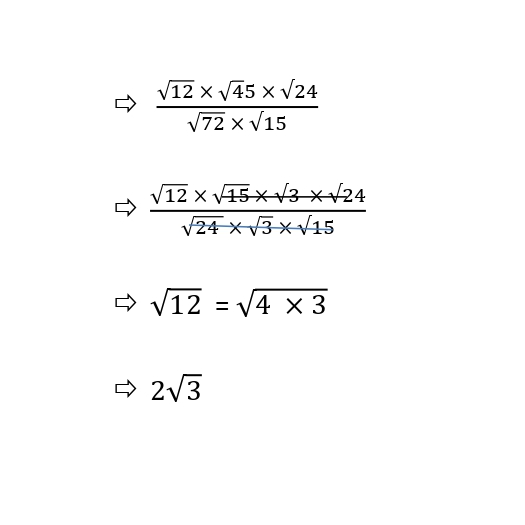
the surds were simplified, so that the values can cancel out.
Summary and conclusion.
Numbers that can be expressed as ratios are rational numbers while numbers that cannot be expressed as ratios are irrational.
Rules 1 and 2 are useful when simplifying surds to the basic form provided a and b are positive numbers.
To get the factors of a surd, divide the surd value by either 2, 3, or 5 and ensure the result is a perfect square, then the result and the divisor are the factors of the surd value.
Exercise.
Simplify the following : 4√2 * √49 (ii) √125 (iii) √8/√2